

Almost every founder who comes to me for help has just fired their cold email agency. Same story every time. They paid $3,000 to $5,000 a month for six months, got weekly PDF reports, and booked zero meetings.
Have you ever paid an agency $4,500 a month and wondered what you’re actually getting? You’re not alone. The path forward is simpler than agencies want you to think.
I’ll show you how to run cold email in-house in 4 weeks, what it actually costs, and the math that changes everything.
The agency math nobody shows you
Every founder who comes to me after firing their agency has the same blind spot. They never ran the math. They paid the retainer, watched the dashboards, and trusted that someone at the agency knew what they were doing.
Most cold email agencies charge $3,000 to $5,000 a month, sometimes with a setup fee on top. They tell you it’s “for managed outbound” and never break it down.
Here’s what running cold email in-house actually costs me and the founders I set up:
- 5 to 10 domains: $75 to $150 per year, paid once
- 15 to 30 inboxes ($5 to $7 per user per month): $75 to $210 per month
- Sending platform with warmup included: $97 to $200 per month
- Email finder and verifier: $50 to $100 per month
After year one, that’s about $230 to $520 per month. Compare it to $4,500 per month for an agency. You save more than $48,000 a year.
One founder I worked with had spent $24,000 with his agency over six months and never booked a meeting. When I asked why he hadn’t run the math, he said the agency told him to “trust the process.”
That’s the agency’s biggest secret. The math itself is the whole pitch. For the full breakdown by category see what does cold email actually cost, and for the honest cold email ROI calculation.
What goes wrong with outsourced cold email
The problem with cold email agencies isn’t laziness. They manage 15 to 20 clients with the same playbook, the same templates, and the same lead databases. Your campaigns get the version of cold email that works for the average client, not the version designed for your business.
When I ask founders what their agency told them about why their campaigns were failing, I hear three answers on repeat: “trust the process,” “we’re building pipeline,” and “market conditions.” Six months pass. They’ve spent $24,000 and have nothing to show for it.
The structural problem is worse than the operational one. Your agency owns the domains, the inboxes, the lead lists, and the reply data. When you cancel, you start from zero.
That’s not a service. It’s a subscription to your own pipeline. (For the long version of why founders keep firing their agencies, see the dedicated piece.)
The 4 systems framework
When I diagnose what’s broken in someone’s cold email, I check four systems in order. Most campaigns fail because one of the four is wrong, and most founders blame the wrong one.
System 1: Infrastructure. Domains, inboxes, warmup, DNS records (SPF, DKIM, DMARC). This is what makes Google trust your sends. If infrastructure is broken, your emails go to spam no matter how good the copy is.
System 2: List. The right people, with verified emails, who actually fit your ICP. Most cold email failures live here. Cold email is roughly 80% list and 20% everything else.
System 3: Message. A clear offer, in short copy, that sounds like a human wrote it. Message only matters when systems 1 and 2 are working. A great email sent through broken infrastructure to the wrong list books zero meetings.
System 4: Process. Follow-ups, reply handling, attribution. Most replies come from the second or third follow-up, not the first send. If your process is send-and-pray, you lose most of the meetings you could have booked.
One founder I worked with had spent three weeks rewriting his cold email copy because his reply rate was at zero. The copy was fine. His warmup hadn’t finished, so his emails were going to spam.
We didn’t change a word of his copy. We gave the warmup another week. Reply rate jumped to 4%. The full 4 systems framework walks through how to diagnose which system is broken in your own setup.
When you hire an agency, you’re paying them to run all four systems for you. When you bring it in-house, you run them yourself. The work is the same; the control is different.
The 4-week setup timeline
When I tell founders cold email setup takes about a month, half of them are surprised it takes that long. The other half thought it would take six months.
The real timeline is four weeks of setup before campaigns start running.
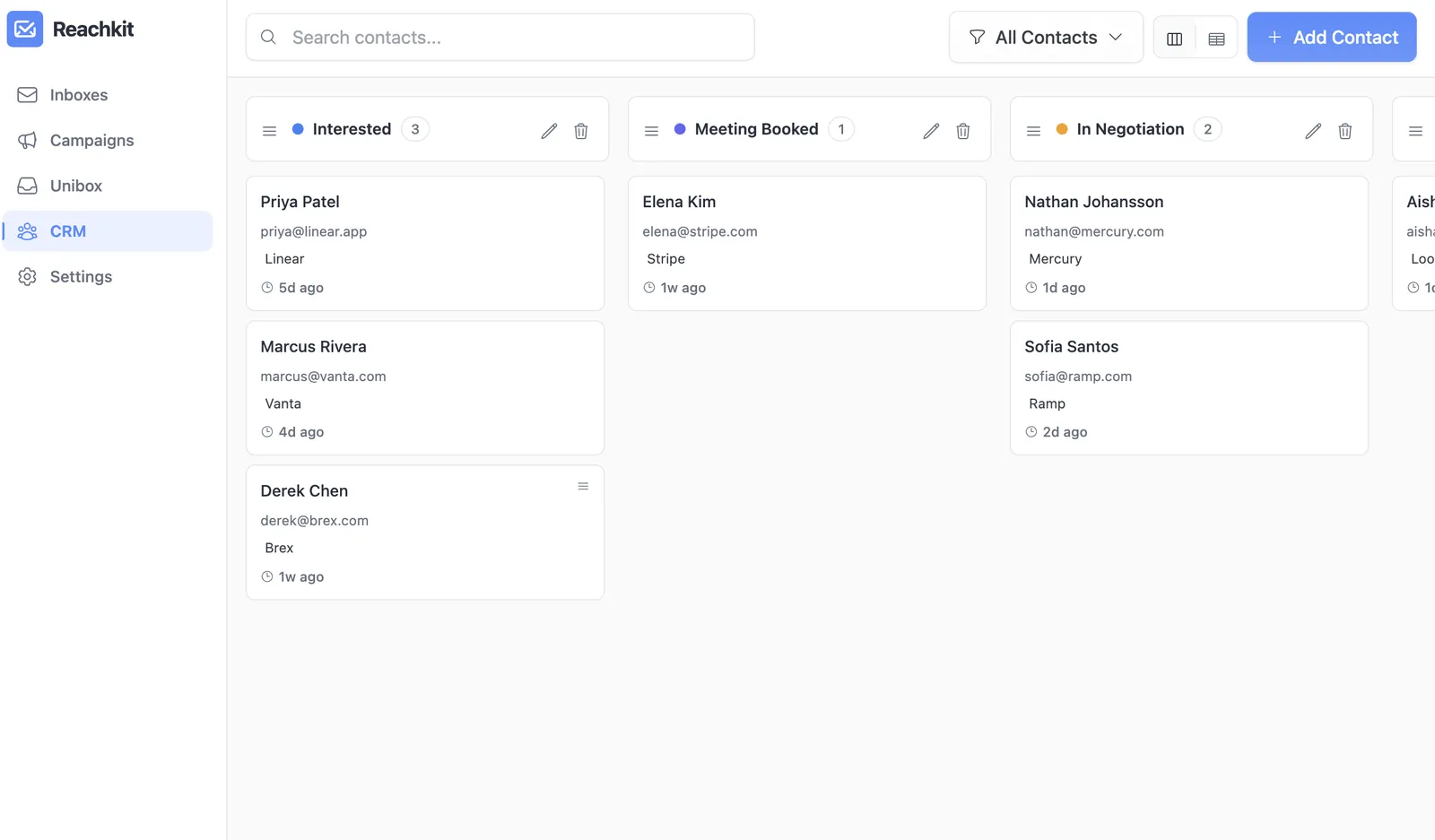
Week 1. Buy 5 to 10 domains, set up Google Workspace inboxes (3 per domain), configure DNS records. About 4 to 6 hours of focused work, or one click in Reachkit if you want to skip the manual setup entirely.
Weeks 2 and 3. Warmup runs in the background. Your sending platform handles it automatically. While that’s happening, you’re building your lead list and writing your first sequence.
Week 4. First real campaigns go out, at small daily volume. From here you’re sending and learning.
Plan for 8 weeks total before judging whether cold email works for you. Anyone testing for 3 weeks tested warmup, not cold email.
What you actually need
Most cold email setups try to sell you eight tools when two or three is the real answer.
The core stack:
- A sending platform. I use Reachkit, which bundles sending, warmup, the unified inbox, a built-in lead finder, and a built-in CRM in one tool. Smartlead and Instantly are reasonable alternatives, but with those you’d usually add a separate lead finder (Hunter, Apollo) and a separate CRM.
- An email verifier if you bring external lists. Bouncer or NeverBounce.
That’s the whole stack. Not 6sense for $30,000 a year. Not Clay for elaborate enrichment workflows.
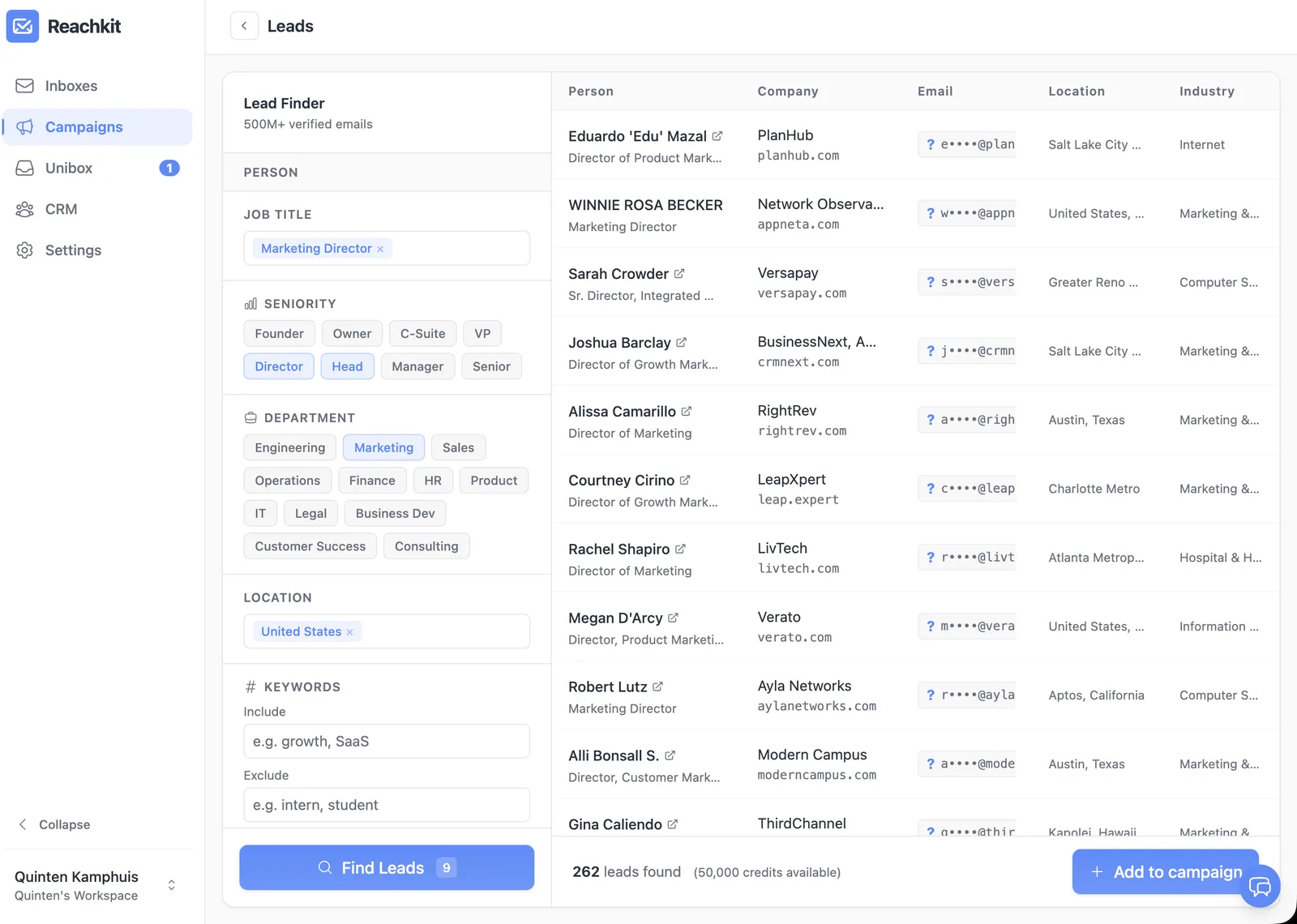
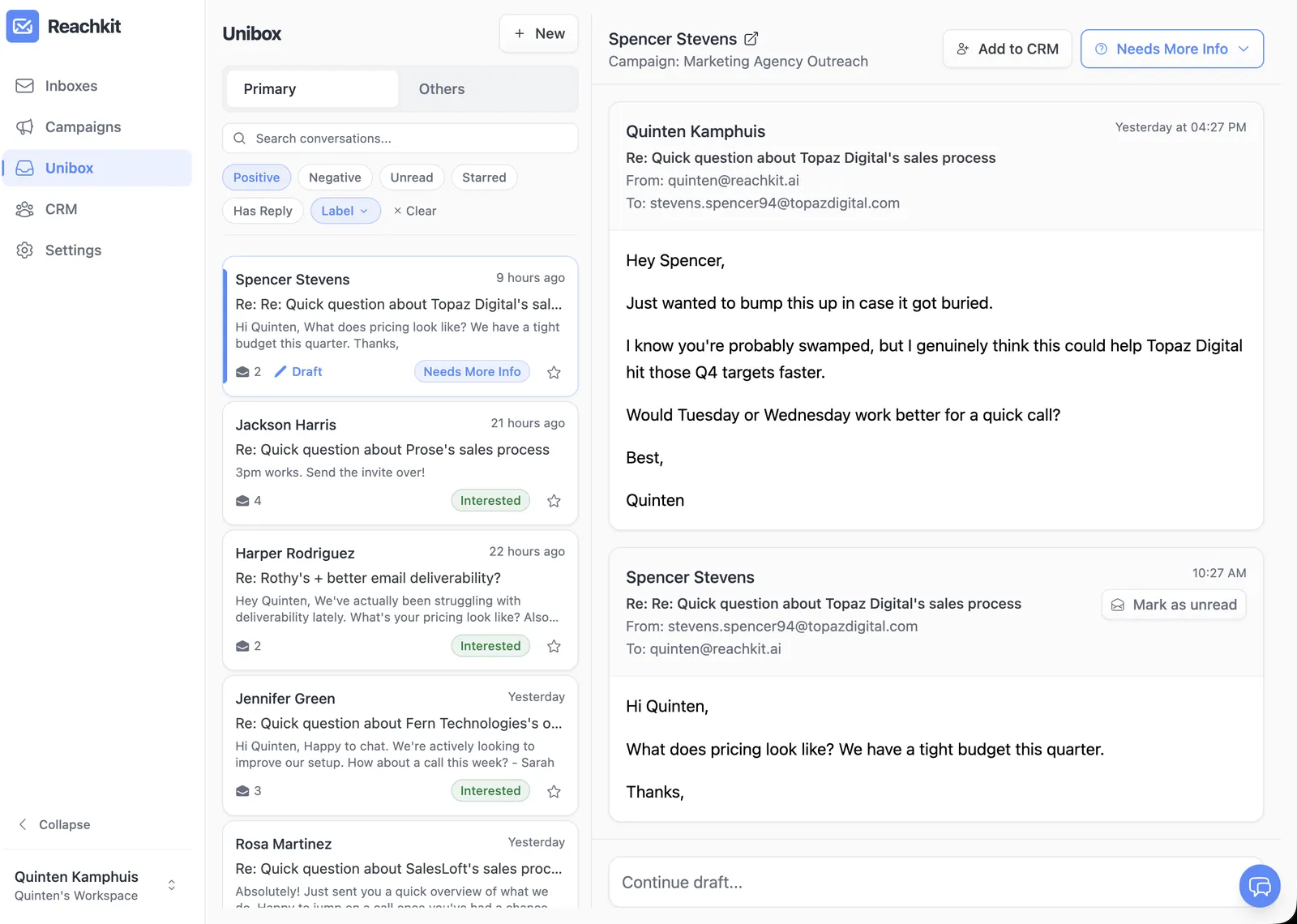
Not a separate CRM if your sending platform already has one. Add tools when a real bottleneck demands them, not because someone’s content marketing told you to.
For the full per-category cost view across platforms, see the true cost of cold email platforms. If you want to go further on list building, lead scraping for cold email walks the decision and Google Maps lead scraping is the concrete workflow for local-business ICPs.
Common fears about doing it yourself
Every founder I set up walks in with the same four fears. None of them survive contact with reality.
“It’s too technical.” DNS records and warmup are unfamiliar, not hard. A few hours of learning pays back for years.
“I’ll burn my domain.” Not if you warm up properly. The platform handles warmup automatically. Burnout happens when founders skip warmup and send 500 emails on day one.
“I don’t have time.” Agency setup takes your time too. The difference is you’re paying $4,500 a month for someone else’s calendar.
“I don’t know cold email well enough.” I didn’t either when I started running campaigns. You learn faster owning the work than reviewing PDF reports.
When an agency actually does make sense
Not every founder should bring cold email in-house. I’ll be the first to say so. Three cases where an agency is the right call:
- You have $5,000+ per month in budget and zero hours per week. If your time is worth more than $200 per hour and you’re spending it on customer calls or product, paying for managed outbound can be rational.
- You’re targeting a niche where the agency has unique data. Some industries have specialized providers who know the territory. Rare but real.
- You’re testing whether outbound works at all. A 3-month agency engagement to validate the channel can be cheaper than a full in-house build.
If none of these apply, in-house wins on every dimension that matters. The full agency-vs-in-house comparison covers cost, time, quality, and risk side by side. For the decision framework specifically, see DIY cold email: should you bring it in-house and when cold email outsourcing actually works.
Your first 30 days running cold email in-house
Here’s what the first month looks like for the founders I set up, week by week:
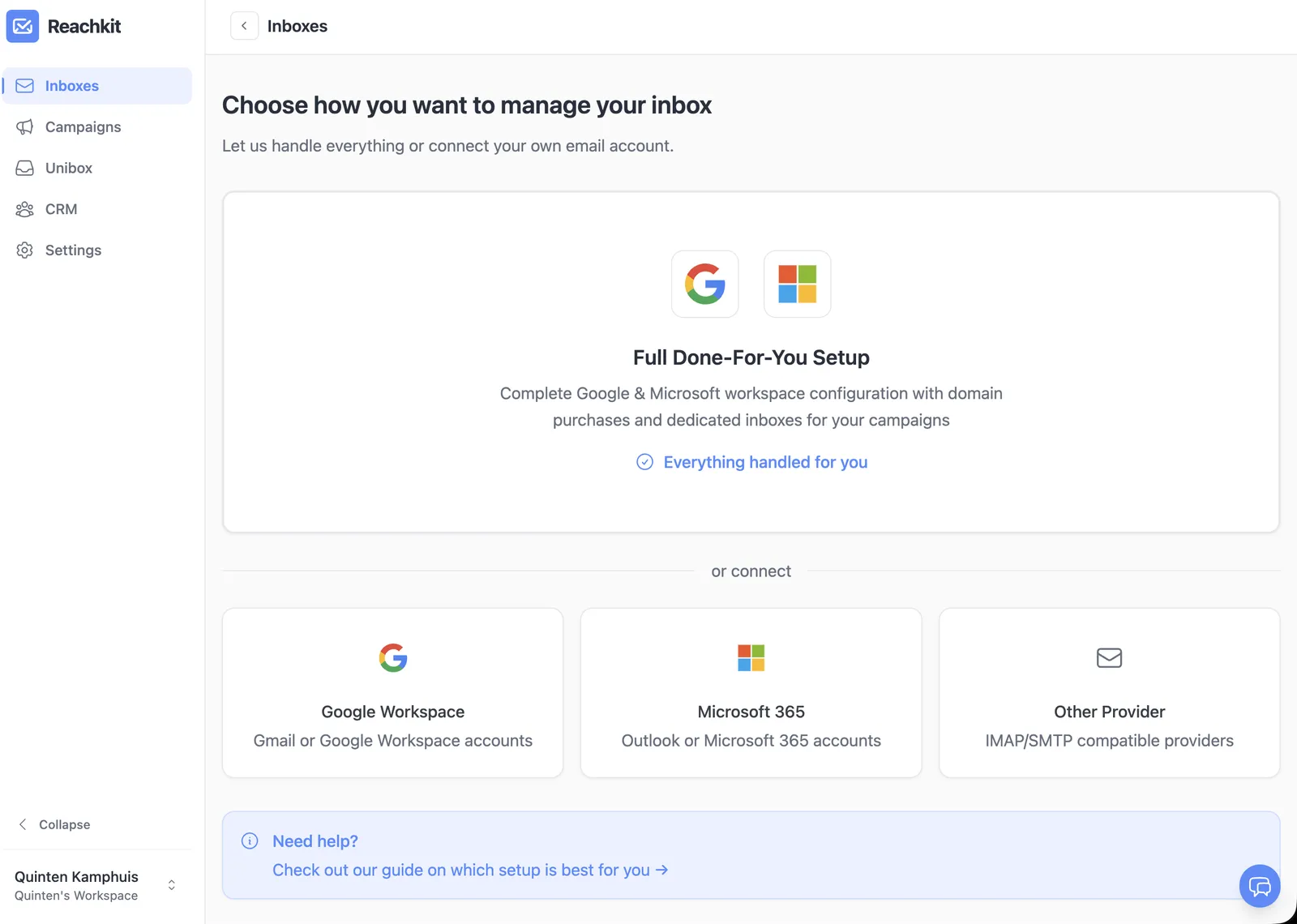
- Days 1-7. Setup. Domains purchased, DNS records configured, inboxes connected, warmup started, sending platform configured.
- Days 8-21. Warmup runs in the background. You spend this time on the list and the copy. Build a list of 1,000 to 3,000 ICP-fit prospects. Write your first sequence (3 emails over 7 days is a fine start).
- Days 22-30. First real sends, at 30 to 50 emails per inbox per day. Reply rates start showing up by day 30.
Don’t expect meetings on day 30. Expect them by day 60. The founders who come to me wanting to test cold email in 3 weeks are usually the ones who quit before the first real send.
If you want help getting started
Some founders want to skip the learning curve and have someone walk through the setup with them. That’s the service I run at reachkit.ai/setup: domains, DNS, inboxes, warmup, list, and first campaign all handled in about 4 weeks.
By vertical: cold email for B2B services, cold email for SaaS, and cold email for consultants each walk the ICP-specific playbook.
You own everything when I’m done. No retainer, no lock-in.
If you’d rather DIY entirely, the rest of this guide gets you there.
FAQ
How long does it take to set up cold email in-house? About four weeks. Week 1 for setup, weeks 2 and 3 for warmup, week 4 for first real sends. Plan for 8 weeks total before judging whether the channel works.
How much does running cold email in-house actually cost? Around $250 to $510 per month for software (sending platform, email finder, verifier, inboxes). Domains are a one-time annual cost of $200 to $400.
Will my domain get burned? Not if you warm up properly. Most platforms handle warmup automatically over 2 to 4 weeks. Burnout happens when founders skip warmup and send full volume on day one.
Do I need to be technical? No. DNS records and warmup are unfamiliar, not difficult. Most setup work is point-and-click in your domain registrar and Google Workspace.
When should I hire an agency instead? When you have $5,000+ per month in budget and genuinely zero hours per week to learn. Or when you’re testing whether outbound works at all and want a quick read.
What’s the minimum viable setup? Two domains, six inboxes, a sending platform with warmup included, an email finder, and an email verifier. Total cost around $200 per month. Enough to send 200 to 400 emails per day after warmup.
What tools do I need? One sending platform (I use Reachkit, which has a lead finder and CRM built in; Smartlead and Instantly are alternatives but typically need a separate lead finder like Hunter or Apollo), and an email verifier (Bouncer, NeverBounce) if you bring external lists. Skip the rest.
What’s a realistic reply rate to expect? 1% to 3% on a generic ICP list, 5% to 10% on a well-segmented list, 7% to 15% on intent-based or hot lists. List quality drives most of the variation.
Bringing it home
Cold email in-house costs about a tenth of what an agency charges, takes 4 weeks to set up, and gives you complete ownership of your pipeline. The work is the same as what an agency does. The control stays with you.
The math is the pitch. $4,500 a month, or $370 a month plus a few hours of your week. If you’re running cold email through an agency right now, run those numbers tonight.
What’s stopping you from owning the channel that books your meetings?
Start your in-house build this week, or try Reachkit free to see what the lean stack actually feels like.