

Have you wondered why your cold email agency keeps reporting “we sent 4,000 emails this month” instead of booked meetings? You’re not the first, and you won’t be the last.
Almost every founder who comes to me for help has just fired or is about to fire their cold email agency. The pattern is so consistent that I now lead with it on most discovery calls.
This article explains why agencies underdeliver, what happens after founders fire them, when keeping the agency is right, and the unsexy truth nobody in the agency space wants to publish.
The pattern: most founders end up firing their agency
Almost every founder who comes to me for cold email help has the same story.
They paid $3,000 to $5,000 per month for 3 to 6 months and got weekly PDF reports. They booked zero or single-digit meetings. When they asked the agency why, they got “trust the process,” “market conditions,” or “your offer needs work.”
The pattern is so consistent that I can predict the agency’s response before the founder finishes telling the story.
Agencies aren’t always lazy. They’re operating on a model that doesn’t fit most founders’ businesses. The full agency-vs-in-house comparison covers the cost, time, and risk math that makes the model break.
What agencies say vs what they actually do
Cold email agencies pitch managed outbound, dedicated SDR-equivalent talent, and proven systems. The reality is mostly templates.
What they actually do:
- Use the same playbook across 15 to 20 clients.
- Pull lead lists from Apollo or ZoomInfo without per-client research.
- Write 1-2 generic sequences per industry with light variable substitution.
- Send reports with sends, opens, and replies. Not meetings.
- Treat objections as “the channel doesn’t work for your business” rather than diagnosing.
The model can’t run any other way. Agencies spread one account manager across many clients to keep margins; spreading means generic.
The lock-in problem
The structural problem with cold email agencies is bigger than execution. It’s ownership.
The agency holds:
- The domains used to send your emails.
- The inboxes those emails come from.
- The lead lists they built.
- The reply data and engagement history.
When you cancel, none of it transfers. You start over.
That’s not a service relationship. It’s a subscription to your own pipeline. Cancel the subscription and you lose the data that justified the subscription.
Most founders only realize this when they try to leave.
What happens after they fire the agency
The fire-the-agency moment is usually triggered by a quarterly review where meetings are still zero, or a moment of math.
The first 4 weeks after firing:
- Week 1. Founder feels equal parts relieved and worried.
- Weeks 2-3. New domains and infrastructure get set up. Warmup runs in the background.
- Week 4. First real campaigns send.
By week 8, most founders have more meetings booked from in-house cold email than they had in their entire 6 months with the agency.
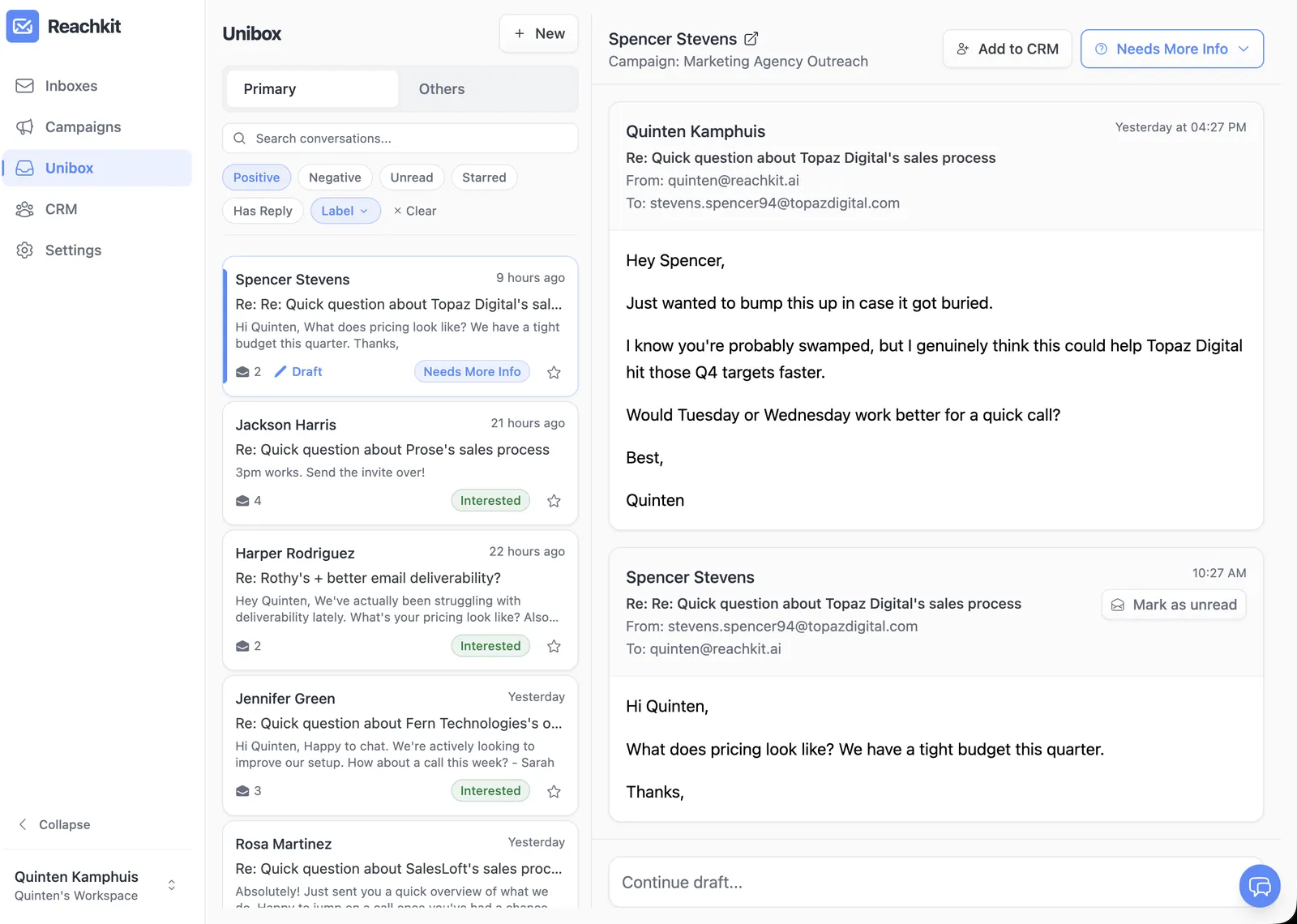
The pattern is consistent enough that it stopped surprising me a long time ago.
When keeping the agency is right
Not every founder should fire their agency. Three cases where the agency is the right call:
- You have $5,000+ per month and zero hours per week. If your time is worth more than the spread, paying for managed outbound can be rational.
- You’re in a niche where the agency has unique data. Some industries have specialized providers. Rare but real.
- You’re testing whether outbound works at all. A 3-month agency engagement to validate the channel is sometimes cheaper than a full in-house build.
If none apply, in-house wins. The math works at every business size where outbound makes sense, and the vertical specifically holds for marketing agencies running their own outbound.
The unsexy truth: the work is the work
The reason in-house cold email outperforms agencies isn’t that founders are smarter than agency account managers. It’s that you care about your pipeline more than they do.
An agency account manager running 15 accounts will never know your ICP the way you do. They won’t adjust messaging based on what you heard on yesterday’s sales call. They won’t feel the urgency of an empty calendar on a Monday morning.
The work that produces meetings is boring: tightening the ICP, verifying the list, writing copy that sounds like a real person, replying to hot leads in 30 minutes.
Agencies can’t do that work as well as you can. Nobody can.
FAQ
Why do most cold email agencies underdeliver? The model requires spreading one account manager across 15-20 clients. Spreading means generic playbooks, generic templates, and generic lists. Specifically targeting your business at the level cold email actually needs isn’t compatible with that economics.
What does it cost to replace a cold email agency with in-house? About $230 to $520 per month for the full software and infrastructure stack, plus 2-4 hours per week of your time. Less than 1/10th of typical agency cost.
Will my agency really keep the domains and lead lists if I cancel? Yes, almost always. The agency owns the registrar accounts, the email accounts, and the lead-list databases. Cancelling means starting from zero.
Does cold email still work in 2026? Yes, when you run it well. Average reply rates have dropped (around 1-3% on generic lists), but signal-based outreach to sharp ICPs is hitting 5-15%. The channel is more selective, not dead.
Is cold emailing illegal? Cold email to business contacts is legal in most jurisdictions including the US (under CAN-SPAM), EU (GDPR with legitimate interest basis), and most others. The rules: identify yourself, give an opt-out, don’t deceive. B2C is more restricted.
What’s the 30/30/50 rule for cold emails? A heuristic: 30% open rate, 30% reply rate of those opens, 50% positive of those replies. Aspirational; real-world averages run 20-40% open and 1-3% reply on the full send list.
How long does it take to replace an agency with in-house cold email? 4 weeks for setup and warmup, then 4 more weeks before the data is meaningful. 8 weeks total to know if the new setup is producing.
Bringing it home
Most founders who come to me for help have either fired or are about to fire their cold email agency. The pattern is consistent because the agency model is structurally generic; cold email demands the opposite.
Fire the agency. Keep the data. Run it yourself.
The exceptions are real but narrow. Walk through them honestly.
If you’re considering the move, the in-house guide covers the setup. Or Reachkit handles the infrastructure if you want to skip the manual work.