

Have you noticed B2B services businesses tend to do better with cold email than SaaS or product companies? It isn’t a coincidence. The economics of B2B services line up with the economics of cold email almost perfectly.
I work with founders running agencies, consultancies, and professional service firms, and the same pattern shows up across every engagement. This article walks through why services is the highest-fit ICP for cold email, the math that makes it work, and the operational playbook.
Why B2B services is the highest-fit ICP for cold email
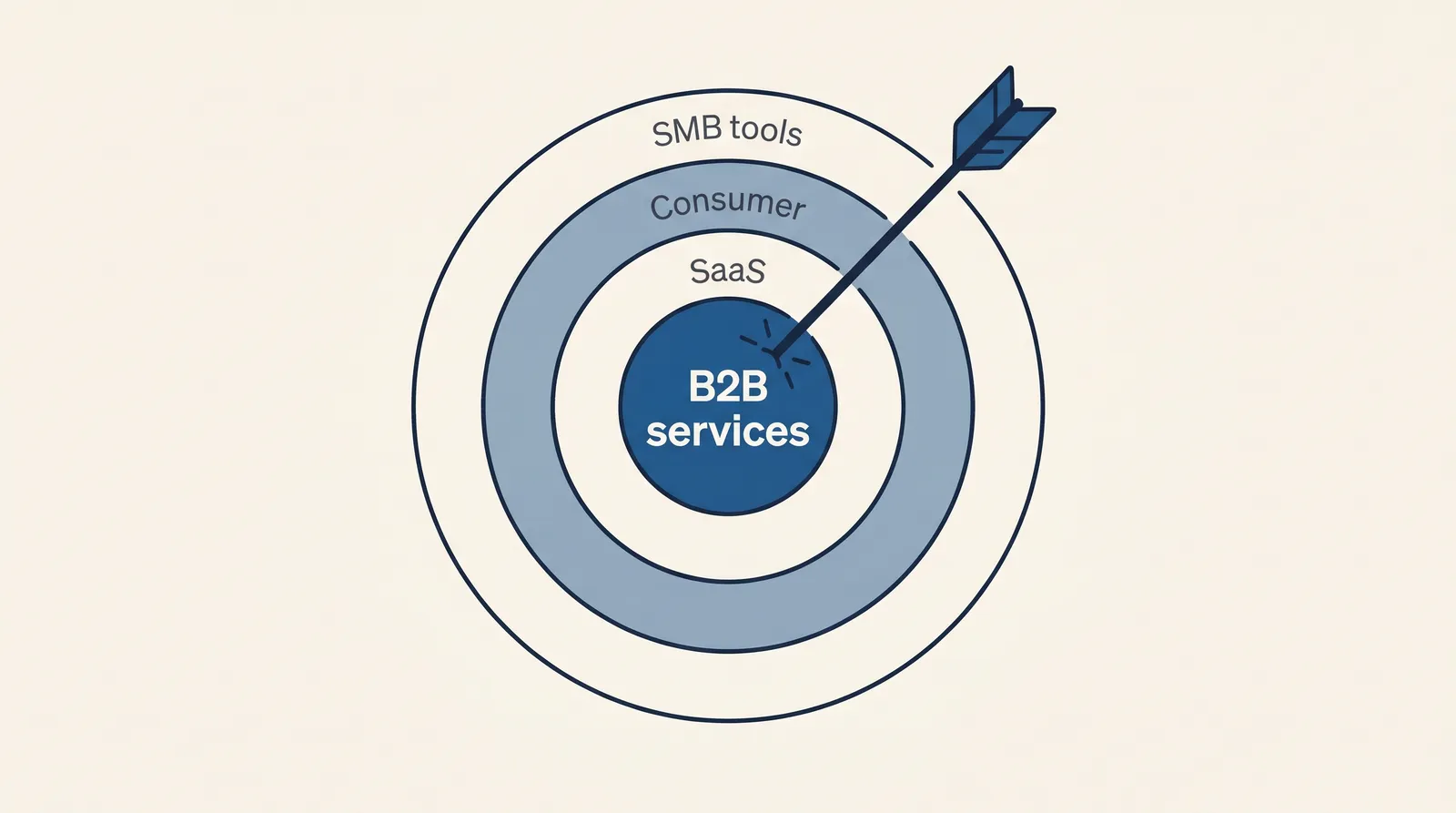
When I look across the founders I work with, the services businesses consistently get the strongest results. Four reasons cold email outperforms for them:
- High deal value. Services deals average $5,000 to $50,000 per engagement, which absorbs the cost-per-meeting math easily.
- Defined buyer. The decision-maker is usually one role (VP Marketing, Head of Sales, COO), making targeting clean.
- Repeatable ICP. A services business that does well with mid-market manufacturers can replicate that pattern across thousands of similar prospects.
- Fast inquiry-to-meeting. Service buyers respond to relevant outreach. They want a partner, not a free trial.
The combination is why cold email for B2B services typically lands 10x to 27x returns where SaaS at the same volume rarely passes 7x. See cold email ROI: how to measure it for the math.
The math: why services beats SaaS at cold email
A side-by-side comparison.
Services (typical):
- Deal value: $15,000 average
- Close rate: 20% (B2B services with tight ICP)
- 11 meetings per month from 5,000 sends
- Monthly revenue: $33,000
- Monthly cost: ~$1,200 in-house
- ROI: ~27x
SaaS (typical):
- ACV: $5,000 per year
- Close rate: 15% (longer sales cycle, more skepticism)
- 11 meetings per month from 5,000 sends
- Monthly revenue: $8,250 ($5,000 ACV × 1.65 meetings closed)
- Monthly cost: ~$1,200 in-house
- ROI: ~6.9x
The structural difference: services collect the full deal value at close, while SaaS recognizes revenue over time. Combined with the higher close rate, services outperforms by 4x at the same volume.
The 4 systems for a services business
The framework I run is the same as any cold email setup: infrastructure, list, message, process. See the 4 systems framework for the foundation.
The services-specific tweaks I apply:
- Infrastructure: Same as any setup. 5 to 10 secondary domains, 15 to 30 inboxes, warmup and DNS.
- List: Tighter than typical. Target the buyer role exactly (VP Marketing, not “marketing decision-makers”).
- Message: Outcome-focused, not capability-focused. Services sell results.
- Process: Discovery call is the CTA, not a demo. Different objection-handling than SaaS.
The biggest difference is in the list and the message. The next two sections walk each.
Service-specific list building
The list discipline I push every services founder to follow:
- Tight company size band. 10 to 200 employees is a typical sweet spot. Below 10, no buying budget. Above 200, procurement gets involved.
- Specific buyer roles. Not “leadership” or “C-suite.” VP Marketing, Head of Sales, COO, CMO, whichever role buys your service.
- Fit signals. Recent leadership changes (new VP usually means new vendors). Recent funding rounds (budget freed up). Tech-stack signals (using a CRM that maps to your service).
A list of 1,000 prospects with these filters outperforms a list of 10,000 prospects without them. Cold email is roughly 80% list and 20% everything else.
Service-specific message
The message difference I teach: services sell outcomes, not features.
A SaaS pitch says “our platform automates X.” A services pitch says “we helped a similar company achieve Y outcome.” The reader doesn’t want to use your platform. They want the result.
Three rules for services messaging:
- Reference work, not capabilities. Specific past results from similar companies beat any capability list.
- One clear outcome per email. Not “we do strategy, execution, and reporting.” Just the outcome the prospect cares about.
- Sound like a partner, not a vendor. Services buyers want a relationship. Marketing-automation tone kills the response.
A well-written services email is shorter than a SaaS email. 60 to 80 words is plenty.
The “discovery call” sequence
The CTA for services is a discovery call, not a demo or trial. I’ve seen founders try to push for a Calendly first-touch and it kills the response rate every time.
A typical 3-touch sequence for B2B services:
- Touch 1 (Day 1): Cold outreach with a relevant observation about their business or industry. Soft ask for a conversation. 60 to 80 words.
- Touch 2 (Day 4): Different angle. Could be a case study reference, a question about their current approach, or a specific insight. Still soft ask.
- Touch 3 (Day 8): Direct ask. “Want to find 20 minutes to compare notes?”
Most meetings book from touches 2 and 3. Founders who quit after one send miss the bulk of their pipeline. See the 8-week test framework for what to expect across timeline.
Common mistakes services businesses make
The five mistakes I find in almost every audit I run on a services-business cold email setup:
- Selling features instead of outcomes. “We do brand strategy” is a feature. “We helped a fintech company grow their qualified pipeline 40% in 6 months” is an outcome.
- Generic ICP. “B2B SaaS founders” is a category, not an ICP. Get specific on size, vertical, and buyer role.
- No follow-up. Most replies come from sends 2 and 3.
- Calendly link as the first touch. Reads as transactional. Open with an observation, not a calendar.
- Pitching everything you do in one email. One outcome per email. The other services come up in the discovery call.
Fix the message, fix the list, fix the follow-up sequence. The rest is execution.
Realistic numbers for a B2B services business
When I check what “working” looks like for a B2B services business running cold email in-house, the numbers I expect to see:
- Reply rate: 2% to 3% with a well-targeted ICP
- Positive replies: 25% of replies (the prospect wants to talk)
- Meeting conversion: 30% to 40% of positive replies
- Meetings per month: 7 to 15 from 5,000 sends
- Close rate: 15% to 25% from meeting to deal
These numbers assume healthy 4-systems execution. If you’re below 2% reply rate at 5,000 sends, your list is the most likely problem. Cold email is roughly 80% list and 20% everything else.
When services + cold email doesn’t work
Not every services business is a fit. Three cases:
- Average deal value under $5,000. Below this, the cost-per-meeting math gets tight.
- Retainer-only model with no clear ROI to the buyer. The buyer needs a reason to switch. Pure retainer pitches with no outcome story struggle.
- Already referral-rich pipeline. If 80% of your pipeline comes from referrals and you’re close to capacity, cold email is more cost than upside.
For everyone else, services + cold email is one of the cleanest channel-fit matches in B2B. For solo experts on the higher end ($15,000+ engagements), see cold email for consultants for the narrower-ICP playbook.
FAQ
Is cold email good for B2B services? Yes. B2B services is the highest-fit ICP for cold email. High deal value, defined buyer, repeatable ICP, fast inquiry-to-meeting conversion. Returns of 10x to 27x on spend are realistic when the 4 systems are healthy.
What’s the best cold email strategy for a B2B service business? Tight ICP (10 to 200 employees, specific buyer roles, fit signals), outcome-focused message, 3-touch sequence with discovery-call CTA. Avoid feature lists and Calendly-first cold outreach.
Cold email vs LinkedIn for B2B services? Cold email scales further (1,000+ touches per week from one operator) and converts faster on direct buyer outreach. LinkedIn wins for warm-network plays and for building authority over time. Most services businesses use both.
Best deal size for cold email in B2B services? $5,000 to $50,000 per engagement. Below $5,000, cost-per-meeting math gets tight. Above $50,000, the sales cycle gets longer but cold email still works as the top of the funnel.
How many meetings should I expect per month from cold email for my services business? 7 to 15 meetings per month from 5,000 sends with a tight ICP. Above that requires higher volume (10,000+ sends) or a sharper niche. Below that points to a list or message problem.
Can a small services agency run cold email in-house? Yes. Most services agencies under 25 employees run cold email better in-house than with an agency. The founder or sales lead knows the buyer best. See the DIY decision guide for the math.
Bringing it home
Cold email for B2B services is the cleanest channel-fit match in B2B. High deal value, defined buyer, fast close cycle.
The math: services typically lands 10x to 27x return on spend when the 4 systems are healthy. The execution: tight ICP, outcome-focused message, 3-touch sequence with discovery-call CTA.
If you sell B2B services and aren’t running cold email, you’re leaving the highest-ROI outbound channel on the table. That’s the conversation I have with every services founder who hasn’t tried it yet.
Start your in-house build this week, or try Reachkit free to see what the services-fit stack looks like.