

Have you been told cold email is for sales teams, not for solo consultants who land work through referrals and LinkedIn? Most consultants believe that. They also keep complaining that their referral pipeline is unreliable and LinkedIn is increasingly saturated.
I work with consultants who get tired of waiting on referrals and want a channel they control. Cold email is that channel. This article walks through the math, the lean stack, and the positioning that gets high-ticket clients without an agency.
Why cold email is the underrated channel for consultants
Three reasons most consultants I talk to overlook cold email:
- LinkedIn reach is dropping for most niches. Every consultant in your space is posting. The replies you get are mostly other consultants pitching collaborations.
- Referrals don’t scale. They produce 3 to 5 client opportunities a year. Cold email produces 3 to 5 client conversations a month from a narrow list.
- Cold email targets the exact buyer. A list of 200 people in roles you serve is more controllable than waiting for the next referral.
Cold email is the channel solo experts can run themselves, control completely, and scale on their own terms.
Consultant is not freelancer
The distinction matters for how you run cold email, and I push every solo expert I work with to be honest about which one they are.
- Freelancer: Capacity-led. Sells hours. Engagements last weeks. Lower ticket ($500 to $5,000 per project).
- Consultant: Expertise-led. Sells outcomes. Engagements last months to quarters. Higher ticket ($15,000 to $100,000+).
The consultant cold-email playbook is different from the freelancer playbook (see cold email for freelancers for that one) and from the agency/services playbook (cold email for B2B services). Different ICP, different message, different sequence.
The rest of this article is about the consultant version.
The lean consultant stack
You don’t need 30 inboxes to land high-ticket clients. The lean stack:
- 2 secondary domains: $30 to $60 per year total
- 6 inboxes (3 per domain): about $42 per month at Google Workspace Business Starter ($6 to $7 per inbox)
- Sending platform with warmup: $40 to $97 per month
- Email finder + verifier: $35 to $80 per month
Total: about $120 to $230 per month software and infrastructure. See the full infrastructure guide for setup details.
Daily volume after warmup: 150 to 300 emails per day. Plenty for a consultant targeting a sharp ICP.
Consultant-specific list building
The list discipline I push consultants toward:
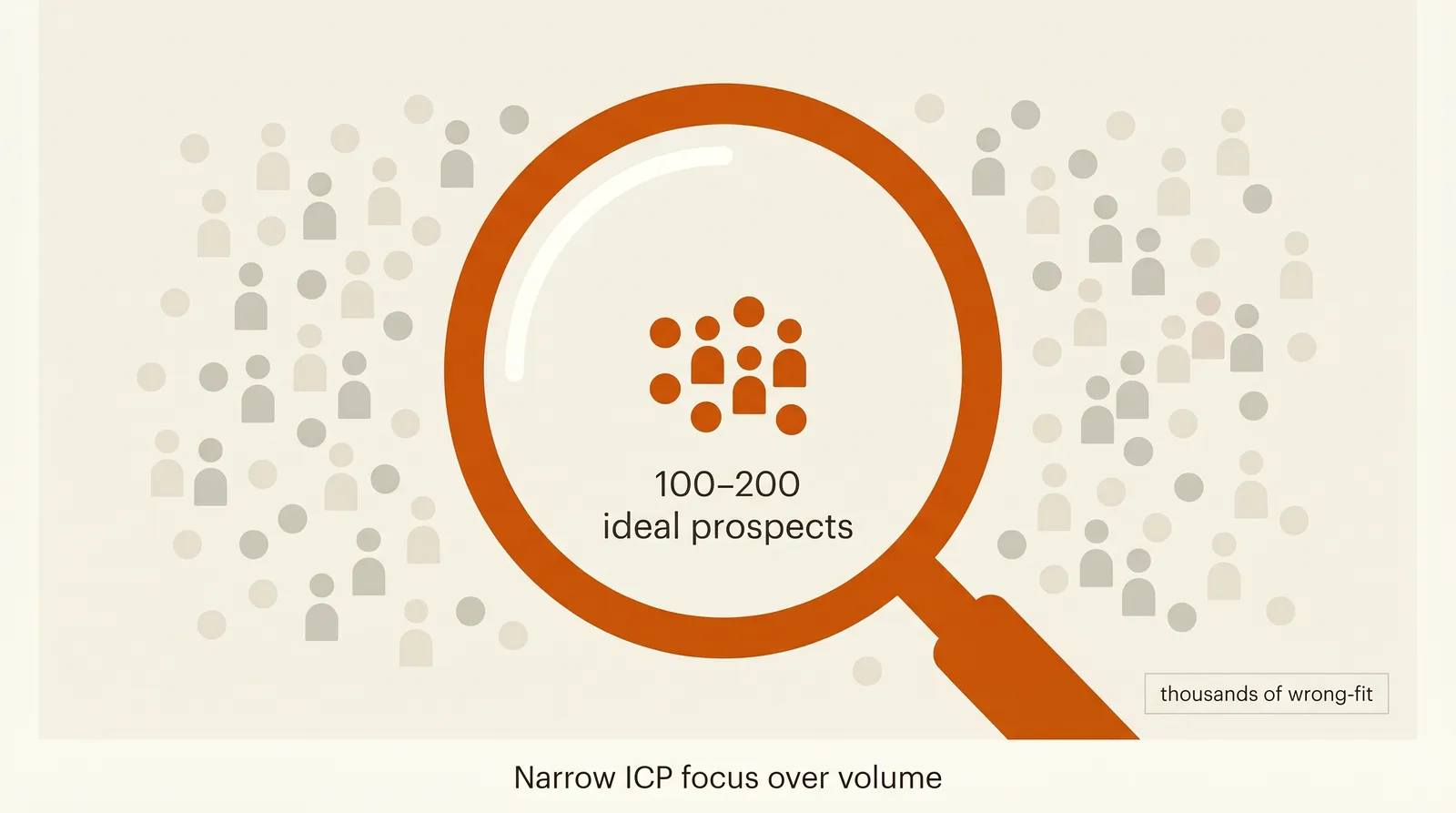
- Narrow ICP. 10 to 20 prospects per week beats 1,000 generic prospects. The right 200 people in roles you serve.
- Specific buyer level. VP, Director, or C-level depending on your practice. A consultant selling org design talks to COO or CHRO, not “leadership.”
- Fit signals. Recent leadership changes (new VP often means new vendor evaluation). Active transformations (new strategy, recent funding, M&A activity). Public hiring patterns that suggest the problem you solve.
A consultant’s list is built one prospect at a time, not scraped in bulk. The selectivity is the differentiator.
Consultant-specific message
The message difference I teach: you sell your POV, not their problem.
A typical SaaS pitch says “you have problem X, here’s how we help.” A consultant pitch starts with your distinct POV on the industry, the trend, the prospect’s specific decision.
Three rules:
- Lead with insight, not pain. A provocative observation about the industry beats a problem statement every time.
- Demonstrate expertise through specificity. A two-sentence take that shows you actually understand their world is worth more than a paragraph of capability claims.
- Sound like the person they’d hire for a board meeting, not a vendor. The tone difference is the credibility test.
A consultant cold email is 80 to 120 words. Shorter than services. Longer than SaaS.
The “insight email” sequence
The CTA for consultants isn’t a discovery call yet. It’s a conversation.
A typical 3-touch consultant sequence:
- Touch 1 (Day 1): A 2-3 sentence insight about their industry, their company, or a trend that affects them. End with a soft question (“curious how you’re thinking about X”).
- Touch 2 (Day 5): A different angle. Could be a related observation, a case reference, or a specific question that demonstrates your expertise.
- Touch 3 (Day 10): Direct ask. “Want to compare notes for 20 minutes?”
Most consultant meetings book from touches 2 and 3. The first touch is the credibility test. The third is the conversion.
What NOT to do as a consultant doing cold email
Five mistakes I see in almost every consultant cold email setup I audit:
- Generic “let me help” positioning. No insight, no POV, no reason to reply. Reads like every other consultant.
- Calendly link as the first touch. Reads transactional. Consultants are hired for judgment, not for being efficient with calendar links.
- Capability pitching. “I do org design, change management, and strategy consulting” tells the prospect nothing.
- Pricing too early. Daily rate or engagement fee in the first email kills credibility. The price comes after the value is established.
- Long credentialing paragraphs. “I’ve worked with Fortune 500 companies and have 20 years of experience” is filler. Specific examples beat credential lists.
Cold email is roughly 80% list and 20% everything else. For consultants, the message matters more than the volume.
Realistic numbers for a consultant
When I check what working looks like for an independent consultant running cold email, the numbers I expect:
- List size: 100 to 200 prospects per week, narrowly selected
- Reply rate: 5% to 10% on a tight expert-led ICP (higher than typical because of selectivity)
- Positive replies: 30% to 40% of replies
- Meeting conversion: 40% to 50% of positives
- Meetings per week: 1 to 4 from 100-200 sends per week, depending on list selectivity
These numbers are higher than what you see for services or SaaS because consultants run narrower lists with sharper messages. Volume is the wrong target for consultants. Fit is.
When cold email works alongside referrals
Cold email isn’t a replacement for referrals. It’s the channel that runs in parallel, and the framing I use with consultants who already have a strong referral pipeline.
Three places cold email adds value to a consultant’s existing pipeline:
- Expanding into a new vertical. Your referral network is in one industry. Cold email opens a second without waiting for organic introductions.
- Targeting a new buyer level. If your referrals are at Director level and you want to land VP engagements, cold email lets you target up.
- Validating a new practice area. Before investing in a new offering, cold email lets you test whether the buyer exists in volume.
Most consultants I work with end up running both. Referrals close warmer, cold email scales further, and the two compound when you do them honestly.
The hourly rate question
The honest math I walk consultants through: at a $300 per hour consulting rate, 2 to 4 hours per week on cold email is $2,600 to $5,200 per month in opportunity cost. That’s $31,000 to $62,000 per year.
That sounds expensive until you compare it to one engagement.
A $60,000 engagement covers a year of cold email opportunity cost at the high end. A $100,000 engagement covers about a year and a half. For consultants at this rate, cold email pays back faster than almost any other marketing investment, including paid ads or content. See the DIY decision guide for the math.
The decision: outsource hours where you can buy them back, run cold email where you can’t replace the judgment.
FAQ
Is cold email worth it for independent consultants? Yes if you’re selling $15,000+ engagements and have 2 to 4 focused hours per week available. One $60,000 engagement covers a year of cold email opportunity cost at the high end. Below $15,000 engagements, the math is tighter.
What’s the best cold email approach for consultants? Narrow ICP (100 to 200 prospects per week), insight-led message, 3-touch sequence with a “compare notes” CTA. Avoid capability pitching and calendar-link cold opens.
Cold email for consultants vs LinkedIn? LinkedIn works for authority and warm-network plays. Cold email works for direct outreach to the specific buyer you want to reach. Most consultants use both; cold email gives you control over who you talk to.
Cold email for consultants vs referrals? Referrals close warmer. Cold email scales further and runs on your timeline. The strongest consultant pipelines run both in parallel.
How many emails should a consultant send per day? Less than you’d think. 30 to 100 per day from a narrow ICP outperforms 500 per day from a generic list. Cold email for consultants rewards selectivity, not volume.
Do I need a sales team to run cold email as a consultant? No. Solo consultants run cold email better than agencies do for them. The judgment about who to target and what to say can’t be delegated.
Bringing it home
Cold email for consultants works when the ICP is narrow, the message leads with insight, and the stack stays lean.
The numbers: 5% to 10% reply rate, 1 to 4 meetings per week from 100-200 sends, one landed $60,000 engagement covers a year of opportunity cost at the high end.
The discipline: write to the specific person you want to work with, not to a category. One sharp email to the right VP beats 100 generic ones to “leadership.”
Build your narrow list this week, or try Reachkit free to see what the lean consultant stack looks like.