

Have you ever calculated cold email ROI honestly? Most founders haven’t. The numbers your platform reports look great, the numbers your agency shows you look great, and the numbers in your bank account don’t tell the same story.
I run cold email for the founders who come to me, and the same pattern shows up every time. They’ve never run the full math themselves, so they trust whatever number they were shown. This article walks through the actual formula, the inputs people skip, and what defensible cold email ROI looks like.
The ROI math founders never run
In every diagnosis I run, the founder has a vague sense that “cold email seems to be working” or “we’re not sure if it’s profitable.” Neither answer comes from running the actual math, and neither survives 10 minutes of me asking them to.
Honest cold email ROI is revenue divided by total spend. The numerator is the closed-deal revenue traceable to the channel. The denominator is software, infrastructure, your labor, and amortized setup.
Most published ROI numbers inflate the first and shrink the second. This article shows the right way to do both.
The formula: revenue ÷ spend, with the right inputs
The cold email ROI formula has four inputs:
- Closed-deal revenue from cold email, over a 12-month window
- Average deal value (or LTV for recurring revenue)
- Total spend including software, infrastructure, and labor
- Time horizon of at least one sales cycle, often 90 days minimum
The formula: ROI multiple = (closed-deal revenue × LTV factor) ÷ total spend.
The number you want to see is somewhere between 5x and 20x annually. Anything under 3x means the channel is barely breaking even after time costs are honest.
What “spend” actually includes (and what founders skip)
The denominator is where most ROI math I’m shown is wrong.
The four spend categories from what does cold email actually cost?:
- Software: $80 to $310 per month
- Infrastructure: $65 to $235 per month
- Labor: $430 to $1,730 per month at $50 to $100 per hour
- Setup amortized: $200 to $400 one-time spread across 12 months
Skipping labor is the single biggest reason ROI numbers lie. If your hours aren’t in the denominator, the math you publish is fiction.
Total monthly spend in a typical in-house setup: $1,000 to $2,500.
What “revenue” actually includes
The numerator has fewer line items but more ways to lie. I see all of them.
Count this:
- Closed-won deals where the first touch was cold email
- LTV not first-month revenue (for recurring deals)
Don’t count this:
- Pipeline (it’s not cash)
- Deals where cold email was the first touch but a referral closed the deal (split-credit honestly)
- Deals from re-engaging existing contacts (that’s nurture, not cold)
Time horizon matters. Cold email pays back over 60 to 90 days minimum. Measuring at month 1 gives you a number that lies.
Worked example: in-house cold email ROI
When I run the math for a typical agency-owner founder I work with, the numbers come out like this.
- Monthly spend: $1,000 (software and infra $300, labor $700 at 3 hours/week × $54/hour)
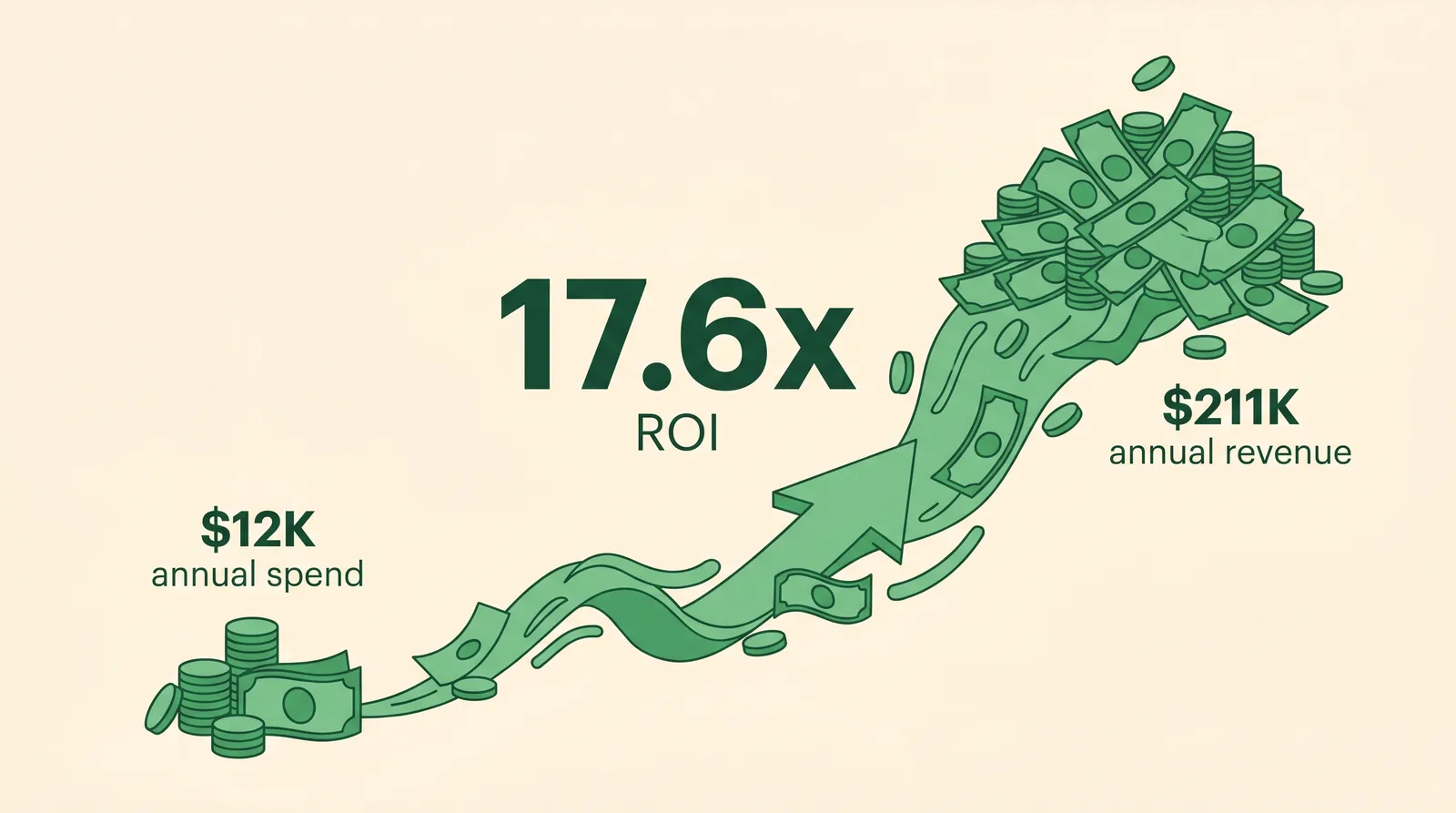
- Annual spend: $12,000
- Monthly volume: 5,000 emails, 3% reply, 25% positive (assumes a well-targeted ICP; average is closer to 15%), 30% meeting conversion = ~11 meetings
- Close rate: 20% (2.2 closes per month)
- Average deal value: $8,000 (B2B services, one-time engagement)
Monthly revenue: 2.2 × $8,000 = $17,600. Annual: $211,200.
ROI = $211,200 ÷ $12,000 = 17.6x.
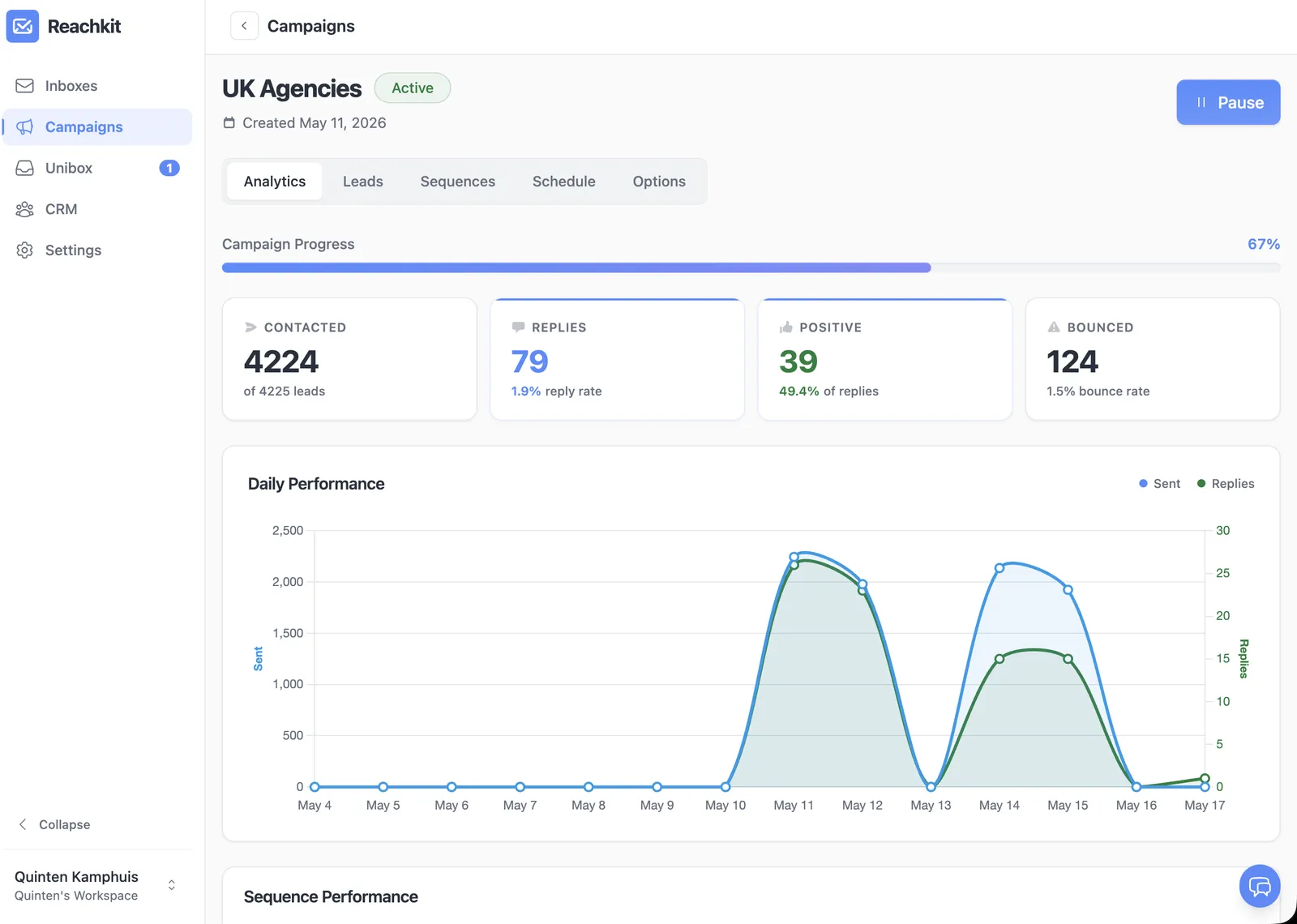
A 20% close rate is realistic for B2B services with a tight ICP. Under 10% means the offer or qualification is off. The 11 meetings/month assumes healthy execution across infrastructure, list, message, and process. See the cost-per-meeting framework for the full funnel.
Worked example: agency cold email ROI
Same campaign, same execution, run by an agency at $4,000/month.
- Annual spend: $48,000
- Meetings: 11 per month (same, the agency runs the same playbook)
- Closes: 2.2 per month at 20% close
- Annual revenue: $211,200
ROI = $211,200 ÷ $48,000 = 4.4x.
That’s the favorable case where the agency executes as well as you would have. Most don’t. The agencies I see up close average 4 to 8 meetings per month from the same volume, not 11.
If the agency produces half the meetings, which is the more common pattern in the audits I run, the ROI drops closer to 2x. That’s why most founders end up firing their agency.
What “good” ROI looks like in 2026
These are my heuristics from running the math across cold email setups, not benchmarks from a published study.
- Under 3x: Channel is barely breaking even after honest time accounting
- 3x to 5x: Working but optimize before scaling
- 5x to 10x: Solid, scale aggressively
- 10x+: Realistic ceiling for in-house with healthy 4-systems execution
Variance is huge by ICP and deal size. A consultant at $25,000 engagements with a tight ICP can hit 30x. A SaaS company at $500 monthly ACV will struggle to hit 3x and probably should use other channels.
Common ways founders fool themselves
The five lies I see in almost every diagnosis I run:
- Counting pipeline instead of closed revenue. Pipeline is hope, not cash.
- Ignoring own labor cost. “Free” if you don’t value your hours, but you do.
- Attributing referral closes to cold email. The first touch and the close are different things.
- Cherry-picking the best month. One $50,000 outlier deal makes any ROI look incredible.
- Counting MRR as one-time revenue. $1,000 MRR isn’t $1,000, it’s $1,000 × LTV.
Each of these can 2x to 5x your reported ROI. Each one is wrong.
The cold email ROI calculator (plug in your numbers)
The inputs:
| Input | Your number | Example |
|---|---|---|
| Monthly sends | 5,000 | |
| Reply rate | 3% | |
| Positive reply rate | 25% | |
| Meeting conversion | 30% | |
| Close rate | 20% | |
| Average deal value | $8,000 | |
| Monthly spend (software + infra + labor) | $1,000 |
The math:
- Meetings = sends × reply × positive × meeting conv (5,000 × 3% × 25% × 30% = 11.25, round to 11)
- Closes = meetings × close rate (11 × 20% = 2.2)
- Annual revenue = closes × deal × 12 ($211,200)
- ROI = annual revenue ÷ annual spend ($211,200 ÷ $12,000 = 17.6x)
If your ROI comes out under 3x, see running cold email in-house for the diagnostic on which system is broken.
FAQ
What’s a good cold email ROI? Practitioner heuristic: under 3x is barely breaking even, 5x to 10x is solid, 10x+ is realistic with healthy 4-systems execution. Variance is huge by ICP and deal size.
How do I calculate cold email ROI honestly? Annual closed-deal revenue from cold email, divided by total annual spend including your labor at your hourly rate. Most published ROI numbers lie by counting pipeline as revenue and skipping labor in the denominator.
Should I include my own labor in cold email ROI? Yes. Skipping labor is the single most common way ROI math lies. If you’re not in the denominator at your hourly rate, the number you’re reporting is fiction.
Cold email vs paid ads ROI? In my experience with B2B services and $10,000+ deal sizes, cold email cost-per-meeting runs 2x to 5x lower than LinkedIn or Google Ads at the same spend, which translates to a higher ROI multiple. For consumer products or low-ACV SaaS, paid usually wins on speed.
How long until cold email is profitable? Plan for 90 days minimum. Weeks 1 to 4 are warmup with no meetings; weeks 5 to 8 are first sends with thin reply data; weeks 9 to 12 give you the data to measure ROI. Anyone judging at week 4 is reading noise.
Why is my cold email ROI low? The four common causes: broken infrastructure (replies going to spam), wrong list (right people aren’t opening), weak follow-up (most replies come from sends 2 and 3), or honest spend was undercounted. Run the 4-systems diagnostic before pulling the plug.
Bringing it home
Cold email ROI is revenue divided by honest spend. Most published numbers inflate the numerator and skip half the denominator, which is why I make every founder I work with run the math themselves.
The math worth running: closed-deal revenue from cold email over 12 months, divided by software, infrastructure, and your labor at your hourly rate.
Real in-house ROI in B2B services lands at 5x to 20x when the 4 systems are healthy. Real agency ROI is 2x to 5x in the same scenario.
Run the math on your own campaigns tonight, or try Reachkit free to see what your in-house number looks like.