

Have you been told every SaaS company should run cold email? Most SaaS marketing advice assumes the answer is yes. The honest answer is “depends on your ACV, your sales motion, and your buyer.”
I work with SaaS founders, and the same pattern shows up: cold email works for some segments of SaaS and backfires for others. This article walks through which segment you’re in, how to run cold email for SaaS when it fits, and when to pick a different channel.
Cold email isn’t always the right channel for SaaS
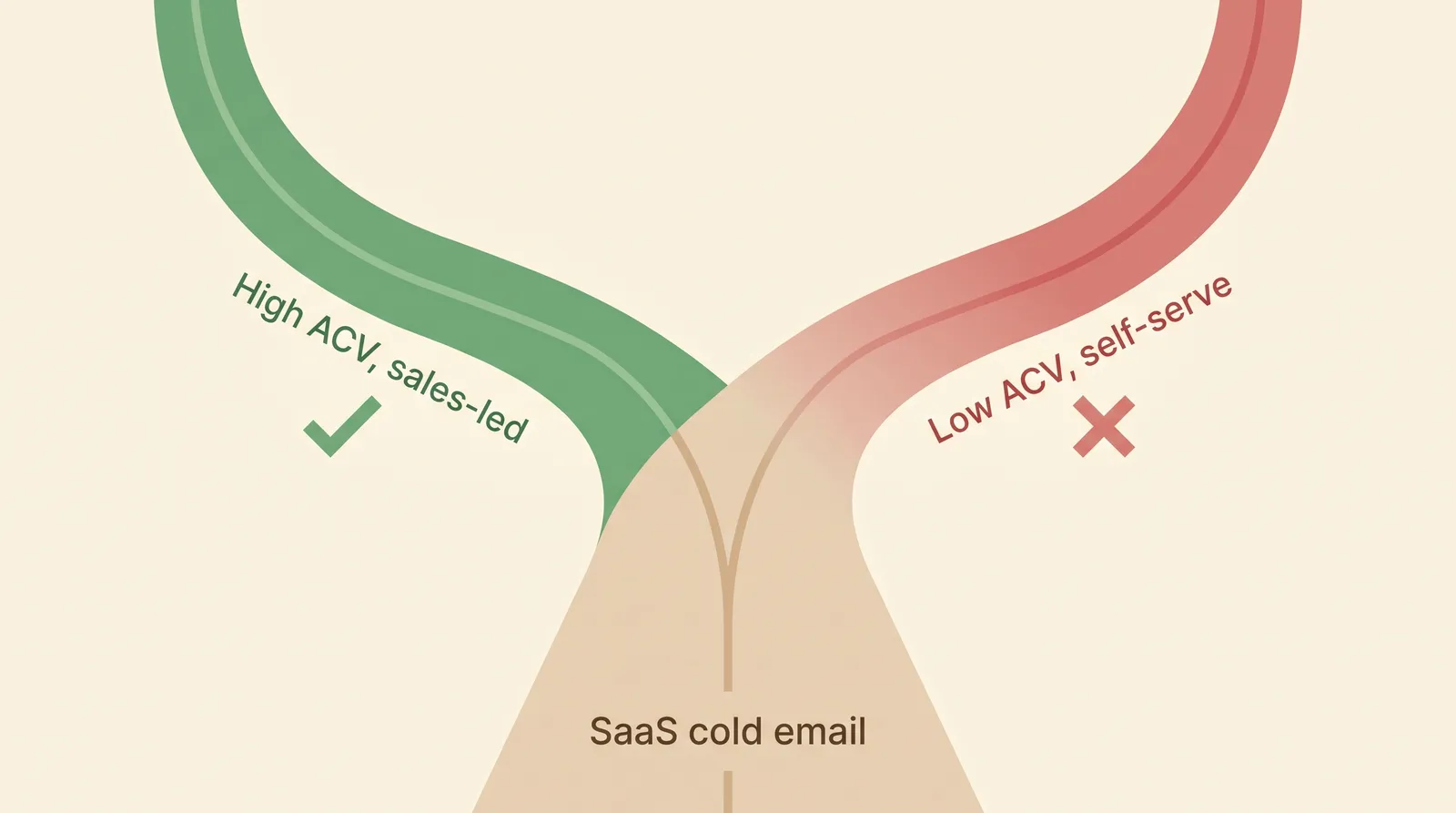
The default SaaS playbook says yes to cold email because it scales and it’s cheap. Both are true. But “scales and cheap” doesn’t mean it works for every SaaS business, and I’ve watched founders burn months on the channel when it was never going to work for their model.
Cold email works for SaaS when:
- The deal is large enough to absorb cost-per-meeting math
- There’s a defined buyer who makes the decision
- The sales motion is human-led (demo, discovery, evaluation)
Cold email backfires for SaaS when:
- ACV is too low for the math to work
- Onboarding is self-serve and there’s no human in the loop
- The buyer is the end user (consumer or low-friction product)
The next sections walk both sides.
When cold email works for SaaS
The conditions I look for before recommending cold email to a SaaS founder:
- ACV $5,000+ per year. At this floor, cost-per-meeting math holds even at conservative close rates.
- Sales-led motion. Reps qualify, demo, and close. There’s a human checkpoint between trial and contract.
- Defined buyer role. VP Sales, VP Marketing, Head of Operations, whatever the role is. One specific title makes the decision.
- 30 to 90 day sales cycle. Long enough that the buyer needs evaluation, short enough that cold email reply still feels relevant 30 days later.
- B2B vertical with a clear ICP. Not horizontal “any business with email” tools. A specific industry, company size, and persona.
If you fit four of these five, cold email for SaaS is a high-ROI channel. If you fit two or fewer, look at other channels first.
When cold email backfires for SaaS
Five scenarios where I tell SaaS founders to pick a different channel:
- ACV under $500 per year. The cost per meeting can’t fit inside the deal margin. Math doesn’t work.
- Self-serve onboarding with freemium. The buyer signs up themselves; there’s no human salesperson to convert a cold reply.
- Consumer-facing or SMB-SaaS with high churn. LTV is too short to absorb acquisition cost.
- No defined buyer role. If the buyer can be anyone in the company, you can’t target the email to a specific person.
- Long evaluation cycles (6+ months). Cold email replies cool off before the deal closes; attribution gets messy.
For low-ACV, freemium, or product-led SaaS, cold email isn’t the channel. Content, paid acquisition, integrations, and partnerships work better. See the DIY decision guide for the channel-vs-channel math, and cold email for B2B services for the comparison that explains why services outperforms SaaS on this channel.
The math: SaaS cost-per-meeting needs to be lower than services
SaaS economics are tighter than services economics on three vectors at once.
At an in-house cost per meeting of $100, the ROI math:
- Services at $15,000 deal, 20% close rate: $100 × 5 meetings = $500 cost per closed deal on a $15,000 deal = 30x return on each closed deal.
- SaaS at $5,000 ACV with 3-year contribution-margin LTV of $10,500, 10% close rate: $100 × 10 meetings = $1,000 cost per closed deal on a $10,500 LTV = 10.5x return on each closed deal.
Services wins on three things at once: higher close rate, deal value collected at close, higher gross margin.
For SaaS specifically, use contribution-margin LTV (LTV × gross margin) in the cost-per-meeting formula, not first-year ACV. See cost per meeting from cold email for the formula.
SaaS-specific list building
The list discipline I push SaaS founders toward:
- Vertical fit. A SaaS targeting B2B fintech is targeting “VP Engineering at series-B+ fintech with 100+ employees,” not “tech companies.”
- Tech-stack fit. If your SaaS integrates with HubSpot, target HubSpot users. If it replaces Mixpanel, target Mixpanel users. Tech-stack signals are the strongest SaaS list filter.
- Buyer role precision. Champion vs decision-maker is a different email. Champion-targeted gets you a demo; decision-maker-targeted gets you a discovery call.
- Recent-signal filtering. Recent funding (budget freed up), recent leadership changes (new vendor evaluation likely), recent product launches (problem freshly defined).
The right buyer at the wrong time still doesn’t reply. SaaS cold email rewards intent timing more than services does.
SaaS-specific message
Three rules I apply to every SaaS cold email I help write:
- Lead with the problem they already have. Not “our platform does X.” It’s “you’re probably running into [specific symptom of the problem we solve].”
- Product-led wedge offers work better than discovery calls. A free trial or sandbox is a lower-friction CTA than “let’s chat.”
- Demo vs trial vs discovery call: pick one CTA per email. The wrong CTA kills the response. Match the offer to the buyer’s friction tolerance.
A SaaS reply rate of 1% to 2% is healthy. SaaS buyers are more skeptical than services buyers, the inbox volume is higher in tech roles, and the email needs to earn the reply with specificity.
The free trial as a hook (not a CTA)
The free-trial offer is a tool, not the CTA itself. The most common mistake I see SaaS founders make in cold email is leading with the trial.
Leading with “sign up for a free trial” in cold email. Most buyers won’t. The trial is friction they don’t want from a cold sender.
The fix: offer the trial as the second touch, after the conversation has started. Touch 1 introduces the problem and the relevance. Touch 2 (or the response to a reply) offers the trial as the obvious next step.
The trial works as a relationship-builder, not a vendor pitch.
Realistic numbers for a B2B SaaS company
When I look at what working looks like for a B2B SaaS running cold email in-house, the numbers I expect:
- Reply rate: 1% to 2% on a tight ICP, lower than B2B services
- Positive replies: 20% to 25% of replies
- Meeting conversion (demo or discovery call): 25% to 35%
- Meetings per month: 3 to 8 from 5,000 sends
- Close rate from meeting: 15% to 25%
If you’re hitting these numbers, the math works. If reply rate is under 1%, your list is probably wrong (most likely vertical-fit or buyer-role precision is off). If meetings book but don’t close, the problem is sales process, not cold email.
Common SaaS-specific mistakes
The four mistakes I find on most SaaS founder audits:
- Pitching the platform instead of the outcome. Same mistake services makes, but worse for SaaS because the product is the pitch.
- Demo as the only CTA. Some buyers want trial. Some want a conversation. Match the CTA to the buyer’s friction tolerance.
- Ignoring tech-stack fit signals. Cold email to “any B2B SaaS” is spray-and-pray. Tech-stack filters tighten the list dramatically.
- Quitting after 2 weeks. Cold email needs 8 weeks minimum to read. SaaS is no exception. See how long to test cold email.
Fix the list, fix the CTA, fix the timing. Most SaaS cold email failures are list problems disguised as message problems.
When to pivot from cold email to other channels
Sometimes cold email isn’t the channel, and I’ll be the first to say so. The signals I look for:
- Meetings book but don’t close repeatedly: ICP is wrong, not cold email
- Reply rate is under 0.5% across multiple list iterations: vertical fit might be missing
- ACV is under $2,000 per year: math doesn’t support cold-email cost-per-meeting
- Self-serve trials convert at 5%+ without sales touch: product-led growth is your real channel
Cold email is a tool. When the math says other tools work better, use those.
FAQ
Is cold email good for SaaS? For B2B SaaS with $5,000+ ACV, sales-led motion, and defined buyer roles: yes. For consumer or low-ACV product-led SaaS: usually no, content and paid acquisition work better.
What’s a good cold email reply rate for SaaS? 1% to 2% is healthy for B2B SaaS with a tight ICP. Below 1% usually points to list problems (vertical fit, buyer role precision, or tech-stack signals).
Cold email for SaaS vs content marketing? Cold email is faster (real data by week 8) but caps lower in volume. Content marketing is slower (6 to 12 months to ramp) but scales further. Most SaaS uses both. Cold email for early traction, content for long-term inbound.
Should I use free trials in cold email for SaaS? Yes, but as a second-touch offer, not the first CTA. The first touch is a problem statement, not a sign-up link. The trial offer comes in the response or follow-up after the reader engages.
What ACV threshold makes cold email work for SaaS? $5,000 annual ACV is a practical floor for sales-led cold email. Below $2,000 ACV, paid and content usually work better. Between $2,000 and $5,000, it depends on close rate and LTV.
Why does cold email backfire for product-led SaaS? Because there’s no human salesperson to convert a cold reply. The buyer signs up themselves; the email reply doesn’t have a destination. Product-led SaaS should use other channels.
Bringing it home
Cold email for SaaS works when ACV is high enough, the motion is sales-led, and the buyer is defined. It backfires when ACV is too low, the motion is self-serve, or the buyer is the end user.
The realistic numbers for B2B SaaS: 1% to 2% reply rate, 3 to 8 meetings per month from 5,000 sends, 15% to 25% close. ROI lands around 10x when the 4 systems are healthy and ACV is high enough to absorb the cost-per-meeting math.
If you fit the profile, run it. If you don’t, use other channels.
Match the channel to the motion, or try Reachkit free to see what the in-house stack looks like at SaaS volume.